
Automation and AI are expected to have significant economic impacts. The important point is that the evidence suggests both substantial gains and substantial disruption. The figures below come from peer-reviewed research, international organizations, and large economic studies—not speculative opinions.
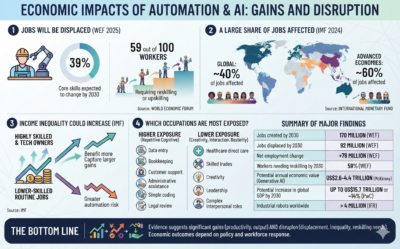
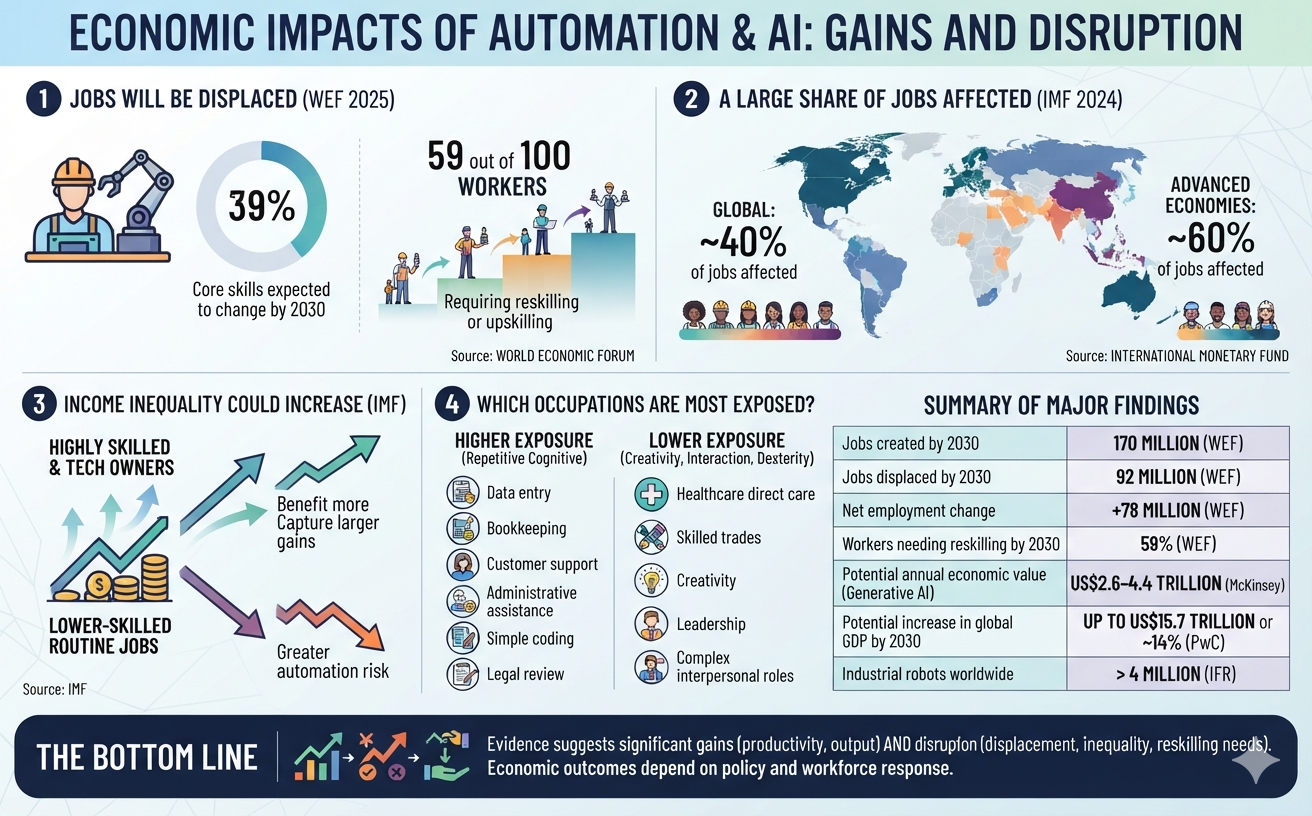
1. Jobs will be displaced
World Economic Forum (2025)
According to the World Economic Forum:
- Around 39% of workers’ core skills are expected to change by 2030.
- Employers estimate that 59 out of every 100 workers will require reskilling or upskilling. Workers who do not receive training face a higher risk of unemployment or reduced earnings.
2. A large share of existing jobs will be affected
The International Monetary Fund estimated in 2024 that:
- AI will affect about 40% of jobs globally.
- In advanced economies, around 60% of jobs will be affected.
- The remaining workers could experience reduced demand for their labour, lower wages, or job displacement if they are unable to adapt.
3. Income inequality could increase
The IMF (International Monetary Fund) found that AI may increase income and wealth inequality because:
- Highly skilled workers often benefit more from AI tools.
- Owners of AI technologies and capital may capture a larger share of economic gains.
- Lower-skilled routine jobs face greater automation risk.
4. Which occupations are most exposed?
Studies consistently find higher exposure in occupations involving repetitive cognitive tasks, such as:
- Data entry
- Bookkeeping
- Basic accounting
- Customer support
- Administrative assistance
- Simple coding tasks
- Basic legal document review
Lower exposure tends to be found in work requiring:
- Physical dexterity in unpredictable environments
- Complex interpersonal interaction
- Leadership
- Creativity
- Skilled trades
- Healthcare requiring direct patient care
Exposure does not necessarily mean replacement; in many cases AI changes how, the work is performed.
Summary of major quantitative findings
| Finding | Evidence |
| Jobs created by 2030 | 170 million (World Economic Forum) |
| Jobs displaced by 2030 | 92 million (World Economic Forum) |
| Net employment change | +78 million (World Economic Forum) |
| Global jobs affected by AI | ~40% (International Monetary Fund) |
| Jobs affected in advanced economies | ~60% (International Monetary Fund) |
| Workers needing reskilling by 2030 | 59% (World Economic Forum) |
| Potential annual economic value from generative AI | US$2.6–4.4 trillion (McKinsey) |
| Potential increase in global GDP by 2030 | Up to US$15.7 trillion or ~14% (Price Waterhouse Coopers) |
| Industrial robots in operation worldwide | More than 4 million (International Financial Reporting) |
Bottom line
The strongest evidence available today does not support the conclusion that AI will necessarily harm the world economy overall. Most major institutions project that AI could increase global productivity and economic output substantially. At the same time, they also identify significant risks:
- Short- to medium-term job displacement in some occupations.
- Increased inequality if AI’s gains are concentrated among high-skilled workers and technology owners.
- Large-scale need for reskilling and workforce transitions.
- Uneven impacts across countries depending on education, infrastructure, and policy.
The economic outcome is therefore likely to depend not only on the technology itself, but also on how governments, businesses, and education systems respond to the transition.