
Extended Reality (XR)
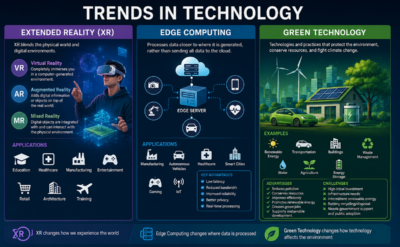
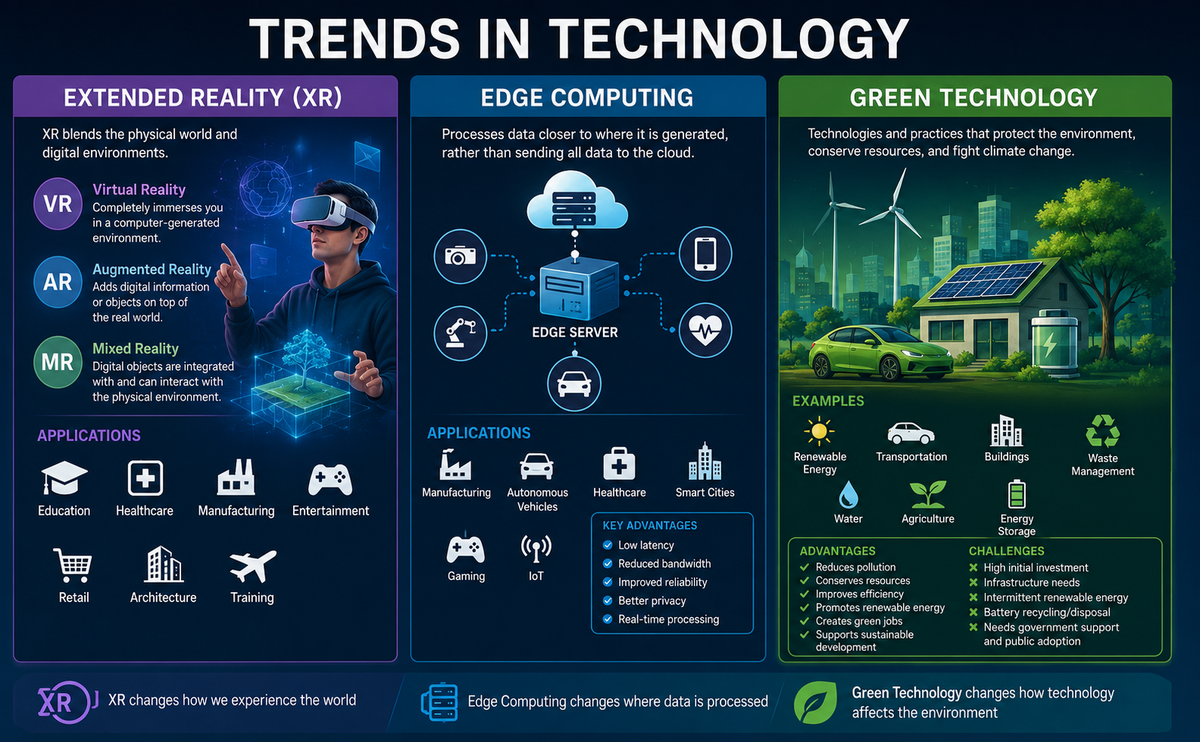
Extended Reality (XR) is an umbrella term for technologies that blend the physical world and digital environments. It includes Virtual Reality (VR), Augmented Reality (AR), and Mixed Reality (MR).
The three main types
Virtual Reality (VR): Completely immerses you in a computer-generated environment.
Example: VR gaming or virtual training simulations.
Augmented Reality (AR): Adds digital information or objects on top of the real world.
Example: Pokémon GO or viewing furniture in your room through a phone camera.
Mixed Reality (MR): Digital objects are integrated with and can interact with the physical environment.
Example: A virtual 3D model appearing on a real table and responding to your movements.
Applications of XR
| Field | Example |
| 🎓 Education | Virtual classrooms and interactive 3D lessons |
| 🏥 Healthcare | Surgical training and medical visualization |
| 🏭 Manufacturing | Remote assistance and equipment simulations |
| 🎮 Entertainment | Immersive games and virtual experiences |
| 🛍️ Retail | Virtual try-ons and product visualization |
| 🏗️ Architecture | Exploring buildings before construction |
| ✈️ Training | Flight, driving, and emergency simulations |
In simple terms:
XR = AR + VR + MR and other technologies that extend or alter our perception of reality.
Edge Computing
Edge Computing is a computing approach where data is processed closer to the place where it is generated, rather than sending all data to a distant cloud or central data centre.
How Edge Computing works
Data is generated by devices such as sensors, cameras, smartphones, or IoT devices.
Data is sent to a nearby edge device/server.
The edge device processes and analyses the data.
Only important results may be sent to the cloud for storage or further processing.
Applications
| Area | Application |
| 🏭 Manufacturing | Real-time machine monitoring |
| 🚗 Autonomous vehicles | Instant analysis of road conditions |
| 🏥 Healthcare | Monitoring patient devices |
| 🏙️ Smart cities | Traffic and surveillance systems |
| 🎮 Gaming | Low-latency gaming |
| 📱 IoT | Processing data from sensors |
Advantages
Low latency: Faster responses because data travels a shorter distance.
Reduced bandwidth: Less data needs to be sent to the cloud.
Improved reliability: Some services can continue working even with limited internet connectivity.
Better privacy: Sensitive data can sometimes be processed locally.
Real-time processing: Useful for applications requiring immediate decisions.
Challenges
Higher deployment and maintenance costs
Many distributed devices need to be secured and managed
Edge devices may have limited computing resources
Physical devices can be vulnerable to tampering
Managing large numbers of edge locations can be complex
Green Technology
Green Technology, also called Clean Technology (Cleantech), refers to technologies and practices designed to protect the environment, reduce pollution, conserve natural resources, and minimize the effects of climate change.
Examples of Green Technology
| Area | Examples |
| ☀️ Renewable Energy | Solar panels, wind turbines, hydropower |
| 🚗 Transportation | Electric vehicles, hydrogen vehicles |
| 🏠 Buildings | Energy-efficient lighting and smart buildings |
| ♻️ Waste Management | Recycling and waste-to-energy systems |
| 💧 Water | Water purification and desalination technologies |
| 🌱 Agriculture | Precision farming and sustainable irrigation |
| 🔋 Energy Storage | Batteries and other energy-storage systems |
Advantages
Reduces pollution and greenhouse-gas emissions
Conserves natural resources
Promotes renewable energy
Improves energy efficiency
Helps address climate change
Can create new green jobs and industries
Supports sustainable development
Challenges
High initial investment costs
Some technologies require advanced infrastructure
Renewable energy can be intermittent
Recycling and disposal of technologies such as batteries can create challenges
Requires government support and public adoption